Managed CRM · Nonprofits
Managed Salesforce for Nonprofits
Not just a donor database. A managed operating system for your mission.
OpenCares Tech manages the Salesforce platform, data, integrations, workflows, reporting and AI that connect your donors, funders, programs, participants, volunteers, partners and staff. You run the mission. We run and continuously improve the system behind it.
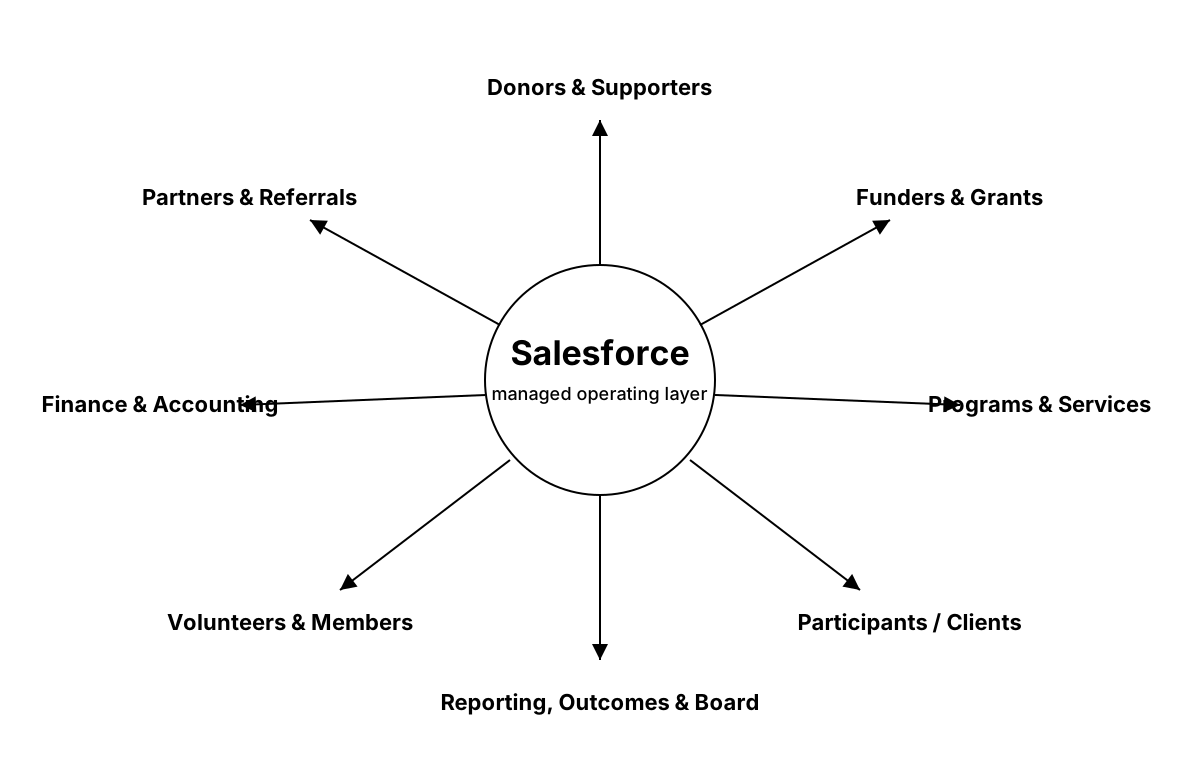
One operating record. Many stakeholder roles. One connected workflow.
Quick answers
What is managed Salesforce for nonprofits?
Managed Salesforce for nonprofits means an external team continuously operates and improves the nonprofit's Salesforce environment — not just implementing it once. OpenCares Tech manages administration, data quality, integrations, workflows, reporting, AI governance, user support and ongoing changes across fundraising and mission-delivery processes.
What does OpenCares Tech manage in Salesforce for nonprofits?
OpenCares Tech manages the Salesforce configuration and the operating layer around it: users and permissions, nonprofit data architecture, workflows, integrations, recurring data-integrity checks, reports, AI-enabled processes, exception handling, licence optimization and continuous improvement.
When should a nonprofit use Salesforce instead of a simpler nonprofit CRM?
Salesforce becomes a stronger fit when fundraising is only one part of the operation and donors, grants, programs, participants, cases, volunteers, partners, finance and reporting must work together. A simpler fundraising CRM can be the better choice when donor management and communications are the primary requirement.
Why use managed Salesforce instead of running Salesforce in-house?
Self-managing Salesforce requires internal capacity for administration, data governance, integrations, releases, reporting, user support and ongoing redesign. A managed model moves that operational responsibility to a team that can monitor the system continuously rather than waiting for problems to become projects.
How is OpenCares Tech different from a conventional Salesforce managed-services provider?
Our target scope extends beyond Salesforce tickets. We manage cross-system workflows, data reconciliation, stuck-process exceptions, licence and SaaS optimization, AI governance and the surrounding technology dependencies required for the nonprofit process to work end to end.
Why nonprofit systems break
Your nonprofit is not one workflow.
A donor may also be a volunteer, member, event attendee, advocate or partner. A participant may move through intake, eligibility, services, referrals and outcomes. A funder may require budgets, milestones, evidence and reports. Finance, fundraising and program teams may all describe the same activity differently.
Most nonprofit technology problems begin when those relationships and workflows are split across fundraising tools, spreadsheets, email, accounting software, forms and point solutions.
Every problem area OpenCares Tech manages
Eight operating clusters, each with the recurring problems nonprofits report and the managed response.
Managed data quality
Your database should not wait for an annual cleanup.
Every week, OpenCares Tech can check Salesforce and connected systems for missing, inconsistent, duplicated, impossible or stalled records.
Completeness
Participant missing required eligibility data
Uniformity
Ontario / ON / Ont. entered as separate values
Validity
Service date occurs before intake date
Duplicate detection
Same donor represented three times
Relationship integrity
Donation has no usable constituent or fund relationship
Workflow compliance
Closed case missing required outcome
Aging / stuck work
Grant application unchanged beyond expected stage time
Integration reconciliation
Payment count does not match gift records
User-entry anomalies
One team has materially higher correction rates
AI readiness
Critical fields needed by an AI workflow are missing
Data quality is not only a database problem. Bad data becomes bad segmentation, bad reports, missed work and unreliable AI.
Nothing important should quietly stop
We manage what falls outside the happy path.
Most systems are designed around what happens when everything works. Nonprofits lose time and money in the exceptions.
Why the platform matters
When one fundraising CRM is enough, use one. When the nonprofit no longer fits inside one, use Salesforce.
Salesforce’s current nonprofit platform, Agentforce Nonprofit (formerly Nonprofit Cloud), can bring fundraising, program and case management, outcomes and other nonprofit workflows onto the broader Salesforce platform. OpenCares Tech then manages the configuration and the connected operating environment around it. The Nonprofit Success Pack (NPSP) remains relevant for organizations already running it; we support existing NPSP orgs as well as newer Agentforce Nonprofit implementations. Existing NPSP org? Read NPSP vs Agentforce Nonprofit: What Existing Nonprofits Need to Know.
One relationship model
Track people, organizations, households and multiple stakeholder roles.
CRM + mission operations
Fundraising can live beside programs, cases, referrals, outcomes and internal workflows.
Flexible data model
Add objects, relationships, fields and processes as the nonprofit changes.
Broad integration surface
Connect forms, payments, email, accounting, documents and external systems.
Reporting & analysis
Move from activity counts to operational and outcome reporting.
Extensible platform
Avoid rebuilding the entire system every time the mission adds a program or requirement.
Comparison 1
Vyop Managed Salesforce vs. purpose-built nonprofit CRMs
Choose a purpose-built nonprofit CRM (Keela, Bloomerang, Neon CRM and similar fundraising-first platforms) when fundraising, donor communications and basic supporter management are the main job and the standard workflow fits. Choose Vyop Managed Salesforce when fundraising is only one part of the operation and donors, grants, programs, participants, volunteers, partners, finance and reporting need to work together.
Vyop/OpenCares fit assessment for a complex nonprofit operating model — not an independent vendor benchmark.
| Dimension | Purpose-built nonprofit CRM | Vyop Managed Salesforce |
|---|---|---|
| Fast fundraising rollout | 5 out of 5 | 4 out of 5 |
| Out-of-box simplicity | 5 out of 5 | 4 out of 5 |
| Program/case operating breadth | 3 out of 5 | 5 out of 5 |
| Custom organizational workflows | 3 out of 5 | 5 out of 5 |
| Integration breadth | 4 out of 5 | 5 out of 5 |
| Outcome/reporting extensibility | 4 out of 5 | 5 out of 5 |
| Long-term adaptability | 3 out of 5 | 5 out of 5 |
| Low internal admin burden | 5 out of 5 | 5 out of 5 |
| Requirement | Purpose-built nonprofit CRM | Vyop Managed Salesforce |
|---|---|---|
| Donor CRM | Excellent | Excellent |
| Donation campaigns | Excellent | Excellent / integrated |
| Fundraising usability out of the box | Often the advantage | More configuration |
| Events / volunteers | Often included or modular | Native/configurable/integrated |
| Programs / service delivery | Usually secondary | Core operating use case |
| Case management | Usually limited or separate | Core operating use case |
| Outcome / impact model | Varies | Extensible and connected |
| Highly custom data types | Vendor-defined | Custom Salesforce data model |
| Complex approvals and handoffs | Moderate | Highly configurable |
| Unusual integrations | Depends on vendor ecosystem | Broad API/platform ecosystem |
| Administration simplicity | Usually easier | More complex platform, offset by managed service |
| Best fit | Fundraising-first nonprofit with standard workflows | Nonprofit with multiple stakeholder and operating workflows |
Best fit when: If the nonprofit's central problem is a standard fundraising workflow and out-of-box simplicity matters most, a purpose-built nonprofit CRM is often the better and cheaper answer.
| Criterion | Vyop Managed Salesforce | Purpose-built nonprofit CRM | General CRM |
|---|---|---|---|
| Fundraising readiness | 4 / 5 | 5 / 5 | 3 / 5 |
| Program & case breadth | 5 / 5 | 3 / 5 | 2 / 5 |
| Custom workflows | 5 / 5 | 3 / 5 | 4 / 5 |
| Integration breadth | 5 / 5 | 4 / 5 | 5 / 5 |
| Reporting & outcomes | 5 / 5 | 4 / 5 | 3 / 5 |
| Long-term adaptability | 5 / 5 | 3 / 5 | 4 / 5 |
Want the deeper product-fit analysis? Salesforce vs Bloomerang vs Keela vs Neon CRM for Nonprofits.
Comparison 2
Vs. general CRMs
A sales CRM (HubSpot, Zoho, Dynamics-style deployments) starts with customers. A nonprofit operating system starts with relationships, funding, services and impact. If the nonprofit's central problem is website marketing, email acquisition and a simple fundraising pipeline, a general CRM may be the better and cheaper answer — Vyop should not force Salesforce where the operational complexity does not justify it.
Vyop/OpenCares fit assessment for a complex nonprofit operating model — not an independent vendor benchmark.
| Dimension | General CRM | Vyop Managed Salesforce |
|---|---|---|
| Marketing / sales workflows | 5 out of 5 | 4 out of 5 |
| Nonprofit stakeholder model | 2 out of 5 | 5 out of 5 |
| Fundraising data model | 3 out of 5 | 5 out of 5 |
| Program / case operations | 2 out of 5 | 5 out of 5 |
| Custom workflows | 4 out of 5 | 5 out of 5 |
| Integration breadth | 5 out of 5 | 5 out of 5 |
| Outcomes / impact measurement | 2 out of 5 | 5 out of 5 |
| Multi-role constituent relationships | 3 out of 5 | 5 out of 5 |
| Requirement | General CRM | Vyop Managed Salesforce |
|---|---|---|
| Contact records | Yes | Yes |
| Email / marketing | Often a major strength | Native or integrated |
| Donation history | Usually custom/integrated | Nonprofit-oriented model |
| Households / constituent relationships | Usually custom | Nonprofit-oriented model |
| Grants | Usually custom pipeline | Purpose-built/custom workflow |
| Programs / services | Usually custom | Native/configurable |
| Case management | Product-dependent | Native/configurable |
| Outcomes | Usually external/custom | Connected outcome model |
| Volunteers | Custom/integrated | Nonprofit capability |
| One person with many nonprofit roles | Possible but requires design | Natural part of the architecture |
| Fundraising + mission delivery | Significant architecture work | Central advantage |
| Platform extensibility | Varies | Strong |
Best fit when: If donor management and communications are the primary requirement, a simpler CRM can be the better choice — Salesforce complexity should be justified by real cross-functional operating needs.
| Criterion | Vyop Managed Salesforce | General CRM | Purpose-built nonprofit CRM |
|---|---|---|---|
| Fundraising readiness | 4 / 5 | 3 / 5 | 5 / 5 |
| Program & case breadth | 5 / 5 | 2 / 5 | 3 / 5 |
| Custom workflows | 5 / 5 | 4 / 5 | 3 / 5 |
| Integration breadth | 5 / 5 | 5 / 5 | 4 / 5 |
| Reporting & outcomes | 5 / 5 | 3 / 5 | 4 / 5 |
| Long-term adaptability | 5 / 5 | 4 / 5 | 3 / 5 |
Comparison 3
Managed vs. self-managed Salesforce
Getting Salesforce is not the same as operating Salesforce well. We do not only measure whether Salesforce is up — we measure whether the process Salesforce exists to support is working.
Vyop/OpenCares fit assessment for a complex nonprofit operating model — not an independent vendor benchmark.
| Dimension | Self-managed Salesforce | Vyop Managed Salesforce |
|---|---|---|
| Admin continuity | 2 out of 5 | 5 out of 5 |
| Data integrity discipline | 2 out of 5 | 5 out of 5 |
| Integration monitoring | 2 out of 5 | 5 out of 5 |
| Workflow exception control | 2 out of 5 | 5 out of 5 |
| User adoption management | 3 out of 5 | 4 out of 5 |
| Licence / stack optimization | 2 out of 5 | 4 out of 5 |
| AI governance | 2 out of 5 | 5 out of 5 |
| Continuous improvement | 2 out of 5 | 5 out of 5 |
| Requirement | Self-managed | Vyop Managed Salesforce |
|---|---|---|
| Administration | Staff become accidental admins | Administration is a managed responsibility |
| Configuration cadence | Configure after complaints | Continuous improvement roadmap |
| Data quality | Clean data during emergencies | Scheduled data integrity audit + remediation |
| Integrations | Assume integrations are working | Monitor and reconcile data flows |
| Reporting | Reports built when someone asks | Recurring operational, board and funder reporting |
| Data entry | Users decide how to enter data | Validation + guided entry + automation |
| Releases | Release changes are ignored | Review changes and update configuration |
| Licences | Buy licences reactively | Licence and utilization optimization |
| AI | AI tools enabled ad hoc | Governed AI use cases and access |
| Institutional knowledge | Departing admin takes knowledge | Documentation and institutional continuity |
| Support | Support lives in email | In-Salesforce support entry point |
| Issue handling | Fix tickets one by one | Identify root cause and prevent recurrence |
| What gets measured | Software uptime | Whether the nonprofit process is working |
Best fit when: A very small nonprofit with light Salesforce use and reliable internal capacity may not need a managed layer yet — the fit strengthens as admin continuity, data integrity and exception volume become real operational risks.
We do not only measure whether Salesforce is up. We measure whether the process Salesforce exists to support is working.
| Criterion | Vyop Managed Salesforce | Self-managed Salesforce |
|---|---|---|
| Admin continuity | 5 / 5 | 2 / 5 |
| Data integrity | 5 / 5 | 2 / 5 |
| Integration monitoring | 5 / 5 | 2 / 5 |
| Workflow exception control | 5 / 5 | 2 / 5 |
| Cost optimization | 4 / 5 | 2 / 5 |
| AI governance | 5 / 5 | 2 / 5 |
Comparison 4
Vyop vs. other Salesforce managed services
Other managed services help you operate Salesforce. Vyop helps Salesforce operate your nonprofit. The differentiator is scope of ownership and operating discipline, not a claim that typical Salesforce MSPs lack admin, development, data quality, AI, training or proactive support — those are increasingly standard managed-services capabilities.
Vyop/OpenCares fit assessment for a complex nonprofit operating model — not an independent vendor benchmark.
| Dimension | Typical Salesforce MSP | Vyop |
|---|---|---|
| Salesforce administration | 4 out of 5 | 5 out of 5 |
| Cross-system workflow ownership | 3 out of 5 | 5 out of 5 |
| Data audit + remediation | 3 out of 5 | 5 out of 5 |
| Workflow exception control | 3 out of 5 | 5 out of 5 |
| SaaS / licence optimization | 2 out of 5 | 4 out of 5 |
| Embedded Salesforce support | 3 out of 5 | 5 out of 5 |
| Integration reconciliation | 3 out of 5 | 5 out of 5 |
| Broader IT / security context | 2 out of 5 | 5 out of 5 |
| Requirement | Typical Salesforce managed service | Vyop operating model |
|---|---|---|
| Tickets/admin | Yes | Yes |
| Development | Yes | Yes |
| Salesforce optimization | Yes | Yes |
| Roadmap | Often | Yes |
| AI/agents | Increasingly | Yes |
| Data quality | Often | Scheduled audit + remediation + trend reporting |
| Integration setup | Yes | Setup + monitoring + reconciliation + recovery |
| Support portal | Usually | Entry point directly from Salesforce |
| Workflow management | Often Salesforce-centric | Own the full workflow across Salesforce + external apps |
| SaaS cost control | Usually secondary | Licence and stack optimization |
| KPI monitoring | Advisory varies | Operational KPI + exception monitoring |
| Data-entry governance | Configuration | Recurring rule enforcement and audit |
| Stuck workflow detection | Varies | Explicit exception queues |
| Report creation | Often on request | Recurring management/funder reporting process |
| AI | Build/configure | Data readiness + access + governance + testing + human control |
| Continuous improvement | Retainer hours | Backlog tied to operational outcomes |
| Wider technology context | Primarily Salesforce | Salesforce + SaaS + integration + security + communications context |
Best fit when: A nonprofit that only needs Salesforce break/fix and periodic development support may be well served by a conventional Salesforce MSP; Vyop's broader operating scope earns its cost when workflow, data and technology span beyond Salesforce alone.
A Salesforce-only provider can reasonably say, “Salesforce is working.” Vyop's target promise is broader: “the workflow is working.”
| Criterion | Vyop | Typical Salesforce MSP |
|---|---|---|
| Salesforce administration | 5 / 5 | 4 / 5 |
| Cross-system ownership | 5 / 5 | 3 / 5 |
| Audit + remediation | 5 / 5 | 3 / 5 |
| Exception management | 5 / 5 | 3 / 5 |
| SaaS/license optimization | 4 / 5 | 2 / 5 |
| Embedded support | 5 / 5 | 3 / 5 |
Read What Should Nonprofit Salesforce Managed Services Include?.
AI that can trust the data it receives
Don’t bolt AI onto bad data.
OpenCares Tech prepares and governs the information AI relies on, connects approved AI capabilities to nonprofit workflows, restricts what users and agents can access, tests outputs and keeps humans in control of consequential actions.
AI should inherit the nonprofit’s data permissions and governance — not create a parallel information system.
What OpenCares Tech manages
Salesforce Administration
Users, permissions, objects, fields, flows, releases and configuration.
Data Integrity
Audits, validation, normalization, duplicates, reconciliation and remediation.
Integrations
Forms, payment systems, email platforms, accounting, documents and external databases.
Workflow Automation
Approvals, tasks, reminders, handoffs, sequences and exception recovery.
Reporting & Outcomes
Management dashboards, funder reports, program KPIs and drill-down analysis.
AI & Knowledge Work
Governed AI, structured extraction, search, drafting, summaries and workflow assistance.
User Adoption & Training
Role-specific experiences, guides, onboarding and usage review.
Licence & SaaS Optimization
Rightsize Salesforce and remove redundant applications where appropriate.
Support & Continuous Improvement
In-Salesforce help, backlog management, recurring reviews and change implementation.
For organizations already on the Non-Profit Success Pack (NPSP)
NPSP is not a scaled-down corporate tool — it’s a nonprofit-native platform with features many organizations already rely on. OpenCares Tech supports and manages existing NPSP orgs alongside newer Agentforce Nonprofit implementations.
Donor-Centric Design
Track gifts, relationships, communication history, and stewardship plans — in one place.
Grant Lifecycle Management
From prospecting to reporting: track deadlines, deliverables, budgets, and outcomes.
Program Impact Tracking
Link services to clients, measure outcomes, and prove your impact — with data funders require.
Volunteer & Event Coordination
Manage sign-ups, hours, and follow-ups without spreadsheets or chaos.
Many nonprofits qualify for free or discounted licences
Salesforce.org’s Power of Us program gives qualifying nonprofit organizations 10 FREE licences.
That’s $3,600/year in software — $0 cost to you.
Typical setup:
• 10 staff = 10 free licences → $0 software cost
• 15 staff = 10 free + 5 discounted ($36/year each) → $180/year total
Compare that to spreadsheets, sticky notes, and lost opportunities.
Verify current eligibility and pricing on Salesforce.org →“But will my team actually use it?”
That’s the real question. We design your system around your workflows — not ours.
Result: 95% adoption rate (vs. 40% with DIY setups)
Real impact from orgs like yours
| Organization | Before | After |
|---|---|---|
| Youth Services (18 staff) | 4 weeks to compile grant reports | 90 minutes — with 100% accuracy |
| Environmental Ed (12 staff) | Donor retention: 61% | Donor retention: 79% (+18%) |
| Health Collective (22 staff) | New staff onboarding: 3 months | New staff onboarding: 5 days |
“We secured a $180K grant we couldn’t have applied for before — because we finally had the data.”
— Executive Director, Rural Health Non-Profit
Managed Salesforce is powerful. It is not automatically the right answer for every nonprofit.
If Salesforce is more system than you need, we will tell you.
| Signal | Strong managed-Salesforce fit |
|---|---|
| Team | ~5+ staff, or fewer with complex operating workflows |
| Stakeholder types | 3+ major types: donors, participants, volunteers, funders, partners, members |
| Systems | 3+ systems/spreadsheets that must exchange data |
| Programs | Multiple programs/services or meaningful case/client workflow |
| Reporting | Multiple funders, board reporting, outcomes or recurring compliance |
| Workflows | Multi-step approvals, handoffs, reminders or exception handling |
| Change | Frequent new programs, grants, reporting requirements or partnerships |
| Salesforce | Existing org lacks reliable admin, or current CRM has been outgrown |
| Internal capacity | Cannot justify dedicated Salesforce/data/integration staff |
Not a strong fit: a very small nonprofit with a single fundraising program, a simple donor list, little service delivery and few integrations may get better value from a simpler fundraising CRM.
You may have outgrown your current setup if…
New major grant
“We have reporting requirements we never had before.”
New program
“There is nowhere clean to put this information.”
Demand surge
“We cannot keep adding staff just to process paperwork.”
Major-donor growth
“We need consistent stewardship and portfolio management.”
Multiple locations / chapters
“Every team has its own spreadsheet.”
New executive / ops leader
“Nobody trusts the numbers.”
Salesforce admin leaves
“Nobody knows how this was built.”
Failed audit / funder report
“It took weeks to reconstruct the evidence.”
CRM replacement discussion
“We have outgrown our donor database.”
Integration project
“We need finance, forms and fundraising connected.”
AI initiative
“We want AI, but the data is not ready.”
Merger / partnership
“We now have two databases and two processes.”
Staff growth
“Everyone enters information differently.”
Staff reduction
“We need to automate the administrative load.”
High turnover
“We keep losing institutional knowledge.”
How an engagement runs
Operating Assessment
Inventory the current Salesforce org, applications, data sources, inflows, user roles, reporting requirements and workflows.
Business Logic & Priorities
Define the mission process, user stories, decision rules and measurable KPIs before deciding what to automate.
Architecture & Data
Map objects, relationships, permissions, integrations, migration and data-quality rules.
Build & Integrate
Configure Salesforce, implement automations and connect external systems.
Validate & Train
Test end-to-end workflows, reconcile data, train each role and prepare go-live.
Manage & Improve
Run recurring audits, support users, monitor exceptions, optimize licences and execute the improvement backlog.
Frequently asked questions
Official Salesforce sources
- Salesforce.org — Nonprofit Cloud (Agentforce Nonprofit)
- Salesforce — Nonprofit pricing (Power of Us)
- Trailhead — Nonprofit Success Pack Basics
Star ratings and radar charts throughout this page are OpenCares Tech / Vyop fit assessments for a complex nonprofit operating model, not independent vendor benchmarks. Reviewed September 2026.
Start with the operating system, not another software demo
Find out what is breaking between your mission and your systems.
We map your data, workflows, applications, reporting requirements, Salesforce configuration and automation opportunities — then show you what should be fixed, integrated, automated or removed.
Already on NPSP? We can assess and manage the existing org. Considering a newer Agentforce Nonprofit implementation? We can assess that architecture too.